
Poster – Evaluation of the Galileo™ Pathogen Solution Next-Generation Sequencing Pipeline for the Identification and Quantification of DNA Viruses in Transplant Patients

Poster – Evaluation of the Galileo™ Pathogen Solution Next-Generation Sequencing Pipeline for the Identification and Quantification of DNA Viruses in Transplant Patients

NGS-based metagenomics in the clinical virology laboratory

Poster Presentation at the Association for Molecular Pathology Conference 2018
Learn more about Galileo™
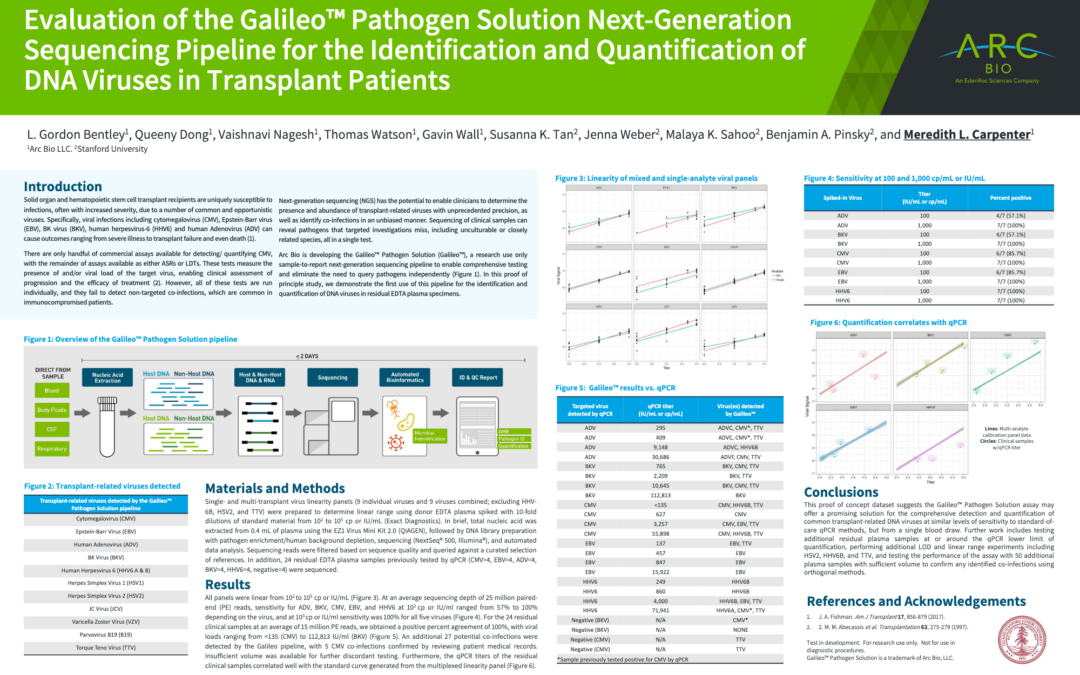
Evaluation of the Galileo™ Pathogen Solution Next-Generation Sequencing Pipeline for the Identification and Quantification of DNA Viruses in Transplant Patients

This poster was presented at the Association for Molecular Pathology Conference, which took place in San Antonio Texas in November 2018 by Dr. Meredith L. Carpenter, Director Of Assay Research & Development at Arc Bio.

Abstract:

“Solid organ and hematopoietic stem cell transplant recipients are uniquely susceptible to infections, often with increased severity, due to a number of common and opportunistic viruses. Specifically, viral infections including cytomegalovirus (CMV), Epstein-Barr virus (EBV), BK virus (BKV), human herpesvirus-6 (HHV6) and human Adenovirus (ADV) can cause outcomes ranging from severe illness to transplant failure and even death.

There are only handful of commercial assays available for detecting/quantifying CMV, with the remainder of assays available as either ASRs or LDTs. These tests measure the presence of and/or viral load of the target virus, enabling clinical assessment of progression and the efficacy of treatment. However, all of these tests are run individually, and they fail to detect non-targeted co-infections, which are common in immunocompromised patients.

Next-generation sequencing (NGS) has the potential to enable clinicians to determine the presence and abundance of transplant-related viruses with unprecedented precision, as well as identify co-infections in an unbiased manner. Sequencing of clinical samples can reveal pathogens that targeted investigations miss, including un-culturable or closely related species, all in a single test.”

In this presentation you will learn:

  • What is NGS-based metagenomics (mNGS) is and how it can be applied to pathogen detection
  • How mNGS compares with and improves upon qPCR as a detection platform
  • What the mNGS workflow looks like when deployed in your laboratory
  • Why deploying mNGS into your laboratory makes sense
  • How Arc Bio has approached mNGS with its Galileo™ platform

[pdf-embedder url=”/wp-content/uploads/2019/06/TPx_Poster_AMP_Layout_103018.pdf”]
For research use only. Not for use in diagnostics or diagnostic procedures.

Do you have a Question about Galileo™

We’d love to hear from you! Do you have any questions about the Galileo™ Platform?

Paper – Metagenomic Next-Generation Sequencing for Identification and Quantitation of Transplant-Related DNA Viruses

Paper – Metagenomic Next-Generation Sequencing for Identification and Quantitation of Transplant-Related DNA Viruses

Enabling NGS-based metagenomics in the clinical virology laboratory

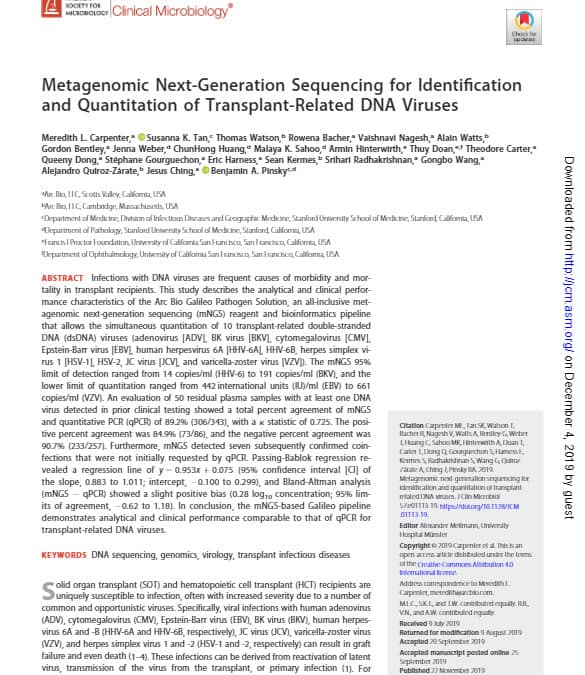
Metagenomic Next-Generation Sequencing for Identification and Quantitation of Transplant-Related DNA Viruses

Here’s our first peer-reviewed publication as a result of a collaborative study between Dr. Benjamin Pinsky, Director of Clinical Virology at Stanford Healthcare, and Arc Bio demonstrating the analytical validity of the Galileo™ platform using both contrived and residual clinical samples as compared to current gold standard methods (qPCR), published in this month’s issue of the Journal of Clinical Microbiology.

Comparable performance of the Galileo™ platform and singleplex qPCR assays across a range of analytical parameters (including sensitivity, limit of detection, and viral quantitation) was reported. The added ability to detect and quantify 397 viral strains simultaneously from a single specimen with Galileo™ potentially translates into significantly lower time and cost burdens for researchers evaluating viral infections and reactivations.

In addition, here’s an interview in Technology Networks by the first author discussing the paper: Infection Identification: Metagenomic Next-generation Sequencing vs PCR

Abstract:

“Infections with DNA viruses are frequent causes of morbidity and mortality in transplant recipients. This study describes the analytical and clinical performance characteristics of the Arc Bio Galileo Pathogen Solution, an all-inclusive metagenomic next-generation sequencing (mNGS) reagent and bioinformatics pipeline that allows the simultaneous quantitation of 10 transplant-related double-stranded DNA (dsDNA) viruses (adenovirus [ADV], BK virus [BKV], cytomegalovirus [CMV], Epstein-Barr virus [EBV], human herpesvirus 6A [HHV-6A], HHV-6B, herpes simplex virus 1 [HSV-1], HSV-2, JC virus [JCV], and varicella-zoster virus [VZV]). The mNGS 95% limit of detection ranged from 14 copies/ml (HHV-6) to 191 copies/ml (BKV), and the lower limit of quantitation ranged from 442 international units (IU)/ml (EBV) to 661 copies/ml (VZV). An evaluation of 50 residual plasma samples with at least one DNA virus detected in prior clinical testing showed a total percent agreement of mNGS and quantitative PCR (qPCR) of 89.2% (306/343), with a κ statistic of 0.725. The positive percent agreement was 84.9% (73/86), and the negative percent agreement was 90.7% (233/257). Furthermore, mNGS detected seven subsequently confirmed coinfections that were not initially requested by qPCR. Passing-Bablok regression revealed a regression line of y = 0.953x + 0.075 (95% confidence interval [CI] of the slope, 0.883 to 1.011; intercept, –0.100 to 0.299), and Bland-Altman analysis (mNGS – qPCR) showed a slight positive bias (0.28 log10 concentration; 95% limits of agreement, –0.62 to 1.18). In conclusion, the mNGS-based Galileo pipeline demonstrates analytical and clinical performance comparable to that of qPCR for transplant-related DNA viruses.”

[pdf-embedder url=”/wp-content/uploads/2019/12/Journal-of-Clinical-Microbiology-2019-Carpenter-e01113-19.full_.pdf” title=”Journal of Clinical Microbiology-2019-Carpenter-e01113-19.full”]

For research use only. Not for use in diagnostics or diagnostic procedures.

Do you have a question about Galileo™?

We’d love to hear from you!