Poster – Evaluation of the Galileo™ Pathogen Solution Next-Generation Sequencing Pipeline for the Identification and Quantification of DNA Viruses in Transplant Patients

Poster – Evaluation of the Galileo™ Pathogen Solution Next-Generation Sequencing Pipeline for the Identification and Quantification of DNA Viruses in Transplant Patients

NGS-based metagenomics in the clinical virology laboratory

Poster Presentation at the Association for Molecular Pathology Conference 2018
Learn more about Galileo™
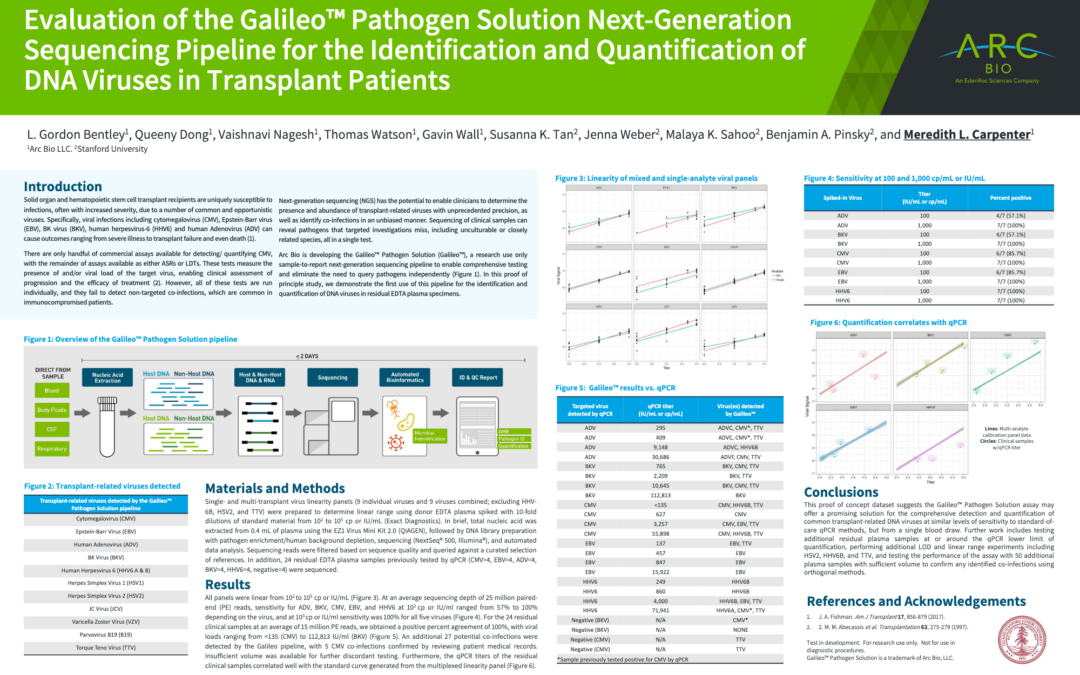
Evaluation of the Galileo™ Pathogen Solution Next-Generation Sequencing Pipeline for the Identification and Quantification of DNA Viruses in Transplant Patients

This poster was presented at the Association for Molecular Pathology Conference, which took place in San Antonio Texas in November 2018 by Dr. Meredith L. Carpenter, Director Of Assay Research & Development at Arc Bio.

Abstract:

“Solid organ and hematopoietic stem cell transplant recipients are uniquely susceptible to infections, often with increased severity, due to a number of common and opportunistic viruses. Specifically, viral infections including cytomegalovirus (CMV), Epstein-Barr virus (EBV), BK virus (BKV), human herpesvirus-6 (HHV6) and human Adenovirus (ADV) can cause outcomes ranging from severe illness to transplant failure and even death.

There are only handful of commercial assays available for detecting/quantifying CMV, with the remainder of assays available as either ASRs or LDTs. These tests measure the presence of and/or viral load of the target virus, enabling clinical assessment of progression and the efficacy of treatment. However, all of these tests are run individually, and they fail to detect non-targeted co-infections, which are common in immunocompromised patients.

Next-generation sequencing (NGS) has the potential to enable clinicians to determine the presence and abundance of transplant-related viruses with unprecedented precision, as well as identify co-infections in an unbiased manner. Sequencing of clinical samples can reveal pathogens that targeted investigations miss, including un-culturable or closely related species, all in a single test.”

In this presentation you will learn:

  • What is NGS-based metagenomics (mNGS) is and how it can be applied to pathogen detection
  • How mNGS compares with and improves upon qPCR as a detection platform
  • What the mNGS workflow looks like when deployed in your laboratory
  • Why deploying mNGS into your laboratory makes sense
  • How Arc Bio has approached mNGS with its Galileo™ platform

[pdf-embedder url=”/wp-content/uploads/2019/06/TPx_Poster_AMP_Layout_103018.pdf”]
For research use only. Not for use in diagnostics or diagnostic procedures.

Do you have a Question about Galileo™

We’d love to hear from you! Do you have any questions about the Galileo™ Platform?

Poster – Evaluation of a Next-Generation Sequencing Metagenomics Assay to Detect and Quantify DNA Viruses in Plasma from Transplant Patients

Poster – Evaluation of a Next-Generation Sequencing Metagenomics Assay to Detect and Quantify DNA Viruses in Plasma from Transplant Patients

Enabling NGS-based metagenomics in the clinical virology laboratory

Poster Presentation given at the Clinical Virology Symposium 2019
Learn more about Galileo™

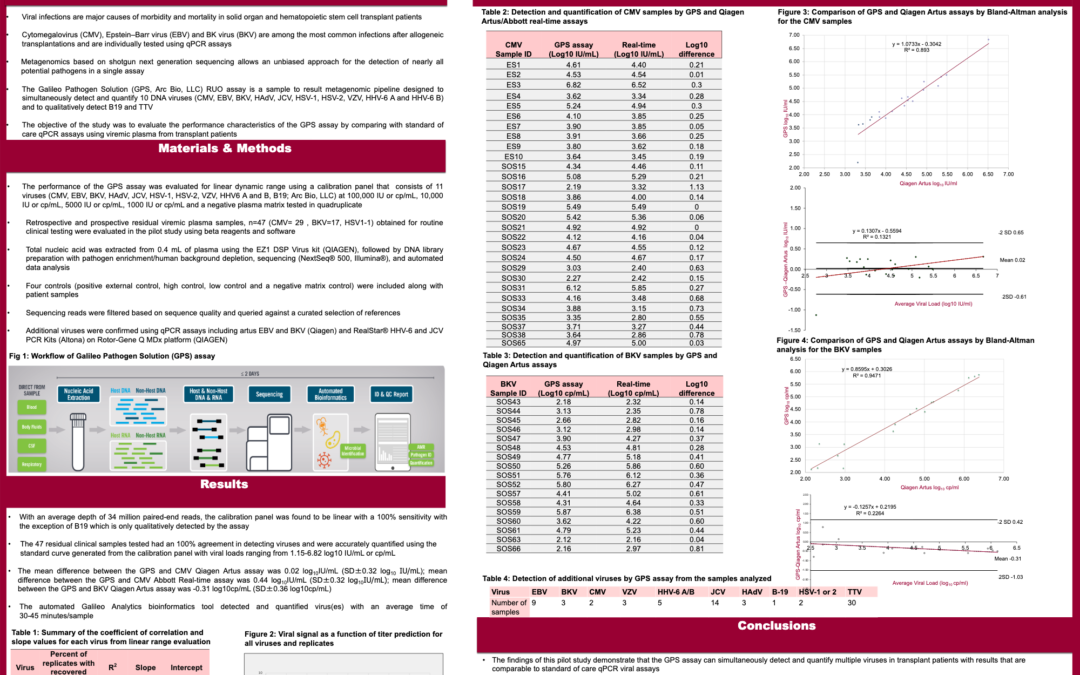
Evaluation of a Next-Generation Sequencing Metagenomics Assay to Detect and Quantify DNA Viruses in Plasma from Transplant Patients

This poster was presented at the Clinical Virology Symposium on May 6th, 2019 by Dr. Soya S. Sam, a member of Dr. Angela Caliendo team  from the Warren Alpert School of Medicine at Brown University.

Abstract:

“Viral infections are major causes of morbidity and mortality in solid organ and hematopoietic stem cell transplant patients Cytomegalovirus (CMV), Epstein–Barr virus (EBV) and BK virus (BKV) are among the most common infections after allogeneic transplantations and are individually tested using qPCR assays.

Metagenomics based on shotgun next-generation sequencing allows an unbiased approach for the detection of nearly all potential pathogens in a single assay. The objective of the study was to evaluate the performance characteristics of the Galillo™-Transplant assay by comparing with standard-of-care qPCR assays using viremic plasma from transplant patients.”

In this presentation you will learn:

  • What is NGS-based metagenomics (mNGS) is and how it can be applied to pathogen detection
  • How mNGS compares with and improves upon qPCR as a detection platform
  • What the mNGS workflow looks like when deployed in your laboratory
  • Why deploying mNGS into your laboratory makes sense
  • How Arc Bio has approached mNGS with its Galileo™ platform

[pdf-embedder url=”/wp-content/uploads/2019/06/Brown-Poster.pdf” title=”Brown Poster”]

For research use only. Not for use in diagnostics or diagnostic procedures.

Do you have a Question about Galileo™

We’d love to hear from you! Do you have any questions about the Galileo™ Platform?

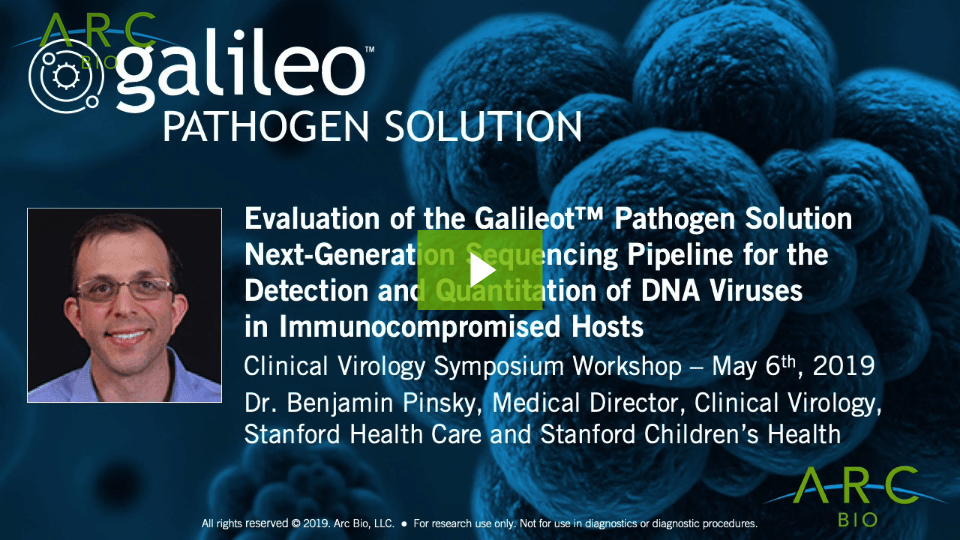
Workshop – Evaluation of the Galileo™ Pathogen Solution Next-Generation Sequencing Pipeline for the Detection and Quantitation of DNA Viruses in Immunocompromised Hosts

Workshop – Evaluation of the Galileo™ Pathogen Solution Next-Generation Sequencing Pipeline for the Detection and Quantitation of DNA Viruses in Immunocompromised Hosts

Evaluation of the Galileo Pathogen Solution Next-Generation Sequencing Pipeline for the Detection and Quantitation of DNA Viruses in Immunocompromised Hosts

Clinical Virology Symposium 2019 – Workshop

Part of a workshop presented at the Clinical Virology Symposium on May 6th, 2019 by Dr. Benjamin Pinsky, Associate Professor of Pathology and Medicine at Stanford Health Care and Stanford Children’s Health.

Dr. Pinsky outlines the current state of clinical virology testing for immunocompromised hosts and presents data from a single institution retrospective study of the Galileo™-Transplant NGS Pipeline for detection and quantitation of DNA viruses conducted at Stanford Health Care.

In this presentation you will learn:

  • Why deploying NGS-based metagenomics (mNGS) into your laboratory makes sense
  • How mNGS compares with and improves upon qPCR as a detection platform
  • How to validate mNGS-based assays in your laboratory
  • How mNGS identified additional viruses missed by conventional qPCR in over 50% of samples

Workshop Video (18:51 minutes):

Workshop Slide Deck (17 slides):

For research use only. Not for use in diagnostics or diagnostic procedures.

Do you have a question about Galileo™?

We’d love to hear from you!

Workshop – Enabling NGS-based metagenomics in the clinical virology laboratory

Workshop – Enabling NGS-based metagenomics in the clinical virology laboratory

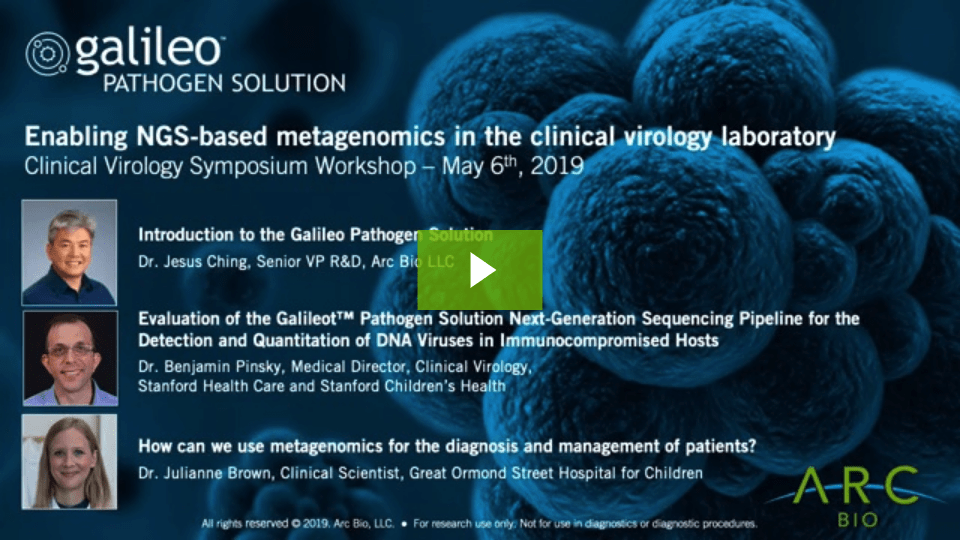
Enabling NGS-based metagenomics in the clinical virology laboratory

Clinical Virology Symposium 2019 – Full Workshop

This workshop was presented at the Clinical Virology Symposium on May 6th, 2019 by:

  • Dr. Benjamin Pinsky of Stanford Health Care and Stanford Children’s Clinic
  • Dr. Julianne Brown of Great Ormond Street Hospital for Children NHS Foundation Trust
  • Dr. Jesus Ching, Senior Vice President of R&D at Arc Bio.

The workshop examines the use of NGS-based metagenomics as a platform for pathogen detection in the clinical virology laboratory.

In these workshop presentations you will learn:

  • What is NGS-based metagenomics (mNGS) is and how it can be applied to pathogen detection
  • How mNGS compares with and improves upon qPCR as a detection platform
  • What the mNGS workflow looks like when deployed in your laboratory
  • Why deploying mNGS into your laboratory makes sense
  • How mNGS has been used to identify unexpected and novel pathogens related to viral encephalitis
  • How mNGS identified additional viruses missed by conventional qPCR in over 50% of samples
  • How to validate mNGS-based assays in your laboratory
  • How Arc Bio has approached mNGS with its Galileo™ platform

Dr. Benjamin Pinsky
Medical Director, Clinical Virology,
Stanford Health Care and Stanford Children’s Health
Evaluation of the Galileo™ Pathogen Solution Next- Generation Sequencing Pipeline for the Detection and Quantitation of DNA Viruses in Immunocompromised Hosts

Dr. Julianne Brown
Clinical Scientist,
Great Ormond Street Hospital for Children NHS Foundation Trust
How can we use metagenomics for the diagnosis and management of patients?

Dr. Jesus Ching
Senior VP R&D, Arc Bio LLC
Introduction to the Galileo™ Pathogen Solution platform

Workshop Video (1 hour 21 minutes):

Dr. Jesus Ching’s Slides (20 slides):

Dr. Ben Pinsky’s Slides (17 slides):

Dr. Julianne Brown’s Slides (21 slides):

For research use only. Not for use in diagnostics or diagnostic procedures.

Do you have a question about Galileo™?

We’d love to hear from you!

Workshop – How can we use metagenomics for the diagnosis and management of patients?

Workshop – How can we use metagenomics for the diagnosis and management of patients?

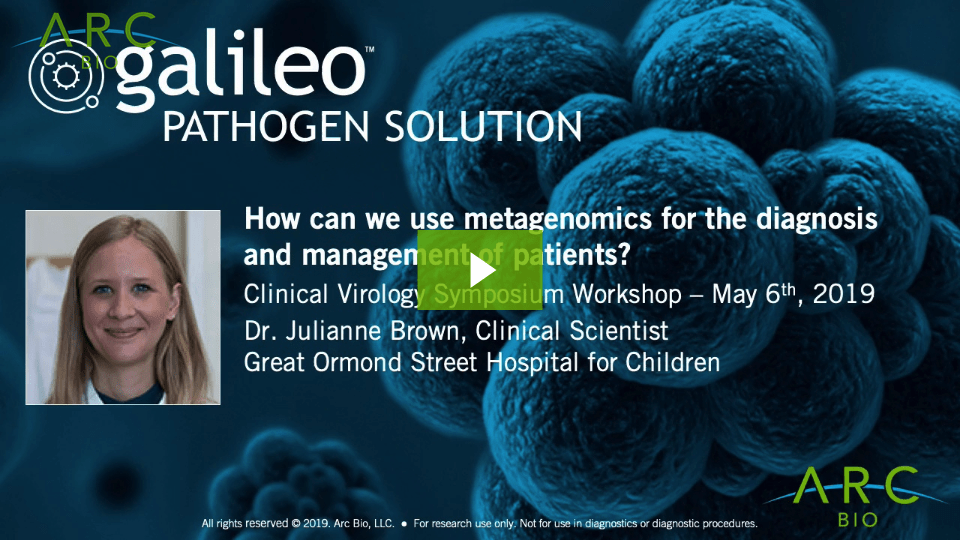
How can we use metagenomics for the diagnosis and management of patients?

Clinical Virology Symposium 2019 – Workshop

Part of a workshop presented at the Clinical Virology Symposium on May 6th, 2019 by Dr. Julianne Brown, Clinical Scientist at Great Ormond Street Hospital for Children NHS Foundation Trust in London.

Dr. Brown discusses the challenges and benefits of using NGS-based metagenomics in the diagnosis and characterization of viral encephalitis cases and it’s a comparison to the use of qPCR as a diagnostics tool.

In this presentation you will learn:

  • What is NGS-based metagenomics (mNGS) is and how it can be applied to pathogen detection
  • What the mNGS workflow looks like when deployed in your laboratory
  • Why deploying mNGS into your laboratory makes sense
  • How mNGS compares with and improves upon qPCR as a detection platform
  • How mNGS has been used to identify unexpected and novel pathogens related to viral encephalitis

Workshop Video (25:35 minutes):

Workshop Slide Deck (21 slides):

For research use only. Not for use in diagnostics or diagnostic procedures.

Do you have a question about Galileo™?

We’d love to hear from you!