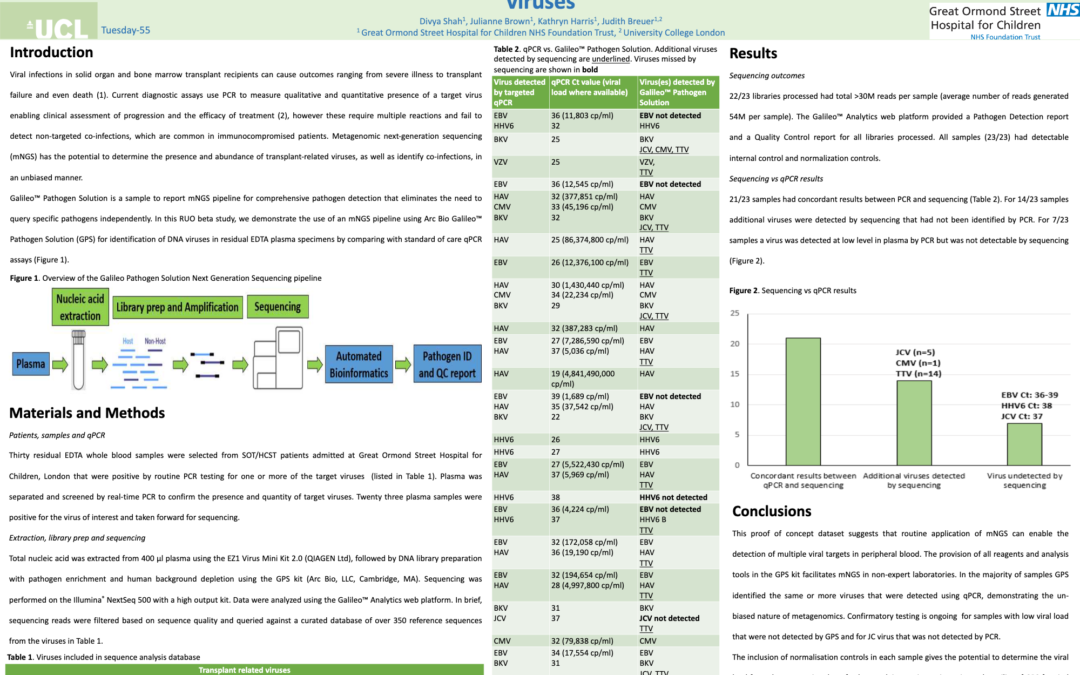
Poster – Performance of an NGS-based metagenomics assay to simultaneously detect and quantify multiple DNA viruses

Poster – Performance of an NGS-based metagenomics assay to simultaneously detect and quantify multiple DNA viruses

Enabling NGS-based metagenomics in the clinical virology laboratory

Poster Presentation given at the Clinical Virology Symposium 2019
Learn more about Galileo™

Performance of an NGS-based metagenomics assay to simultaneously detect and quantify multiple DNA viruses

This poster was presented at the Clinical Virology Symposium on May 6th, 2019 by Dr. Julianne Brown, Clinical Scientist in the Virology Department at Great Ormond Street Hospital for Children NHS Foundation Trust in London.

Abstract:

“Viral infections in solid organ and bone marrow transplant recipients can cause outcomes ranging from severe illness to transplant failure and even death. Current diagnostic assays use PCR to measure qualitative and quantitative presence of a target virus enabling clinical assessment of progression and the efficacy of treatment, however, these require multiple reactions and fail to detect non-targeted co-infections, which are common in immunocompromised patients.

Metagenomic next-generation sequencing (mNGS) has the potential to determine the presence and abundance of transplant-related viruses, as well as identify co-infections, in an unbiased manner.”

In this presentation you will learn:

  • What is NGS-based metagenomics (mNGS) is and how it can be applied to pathogen detection
  • How mNGS compares with and improves upon qPCR as a detection platform
  • What the mNGS workflow looks like when deployed in your laboratory
  • Why deploying mNGS into your laboratory makes sense

[pdf-embedder url=”/wp-content/uploads/2019/07/GOSH-poster.pdf” title=”GOSH poster”]
For research use only. Not for use in diagnostics or diagnostic procedures.

Do you have a Question about Galileo™

We’d love to hear from you! Do you have any questions about the Galileo™ Platform?

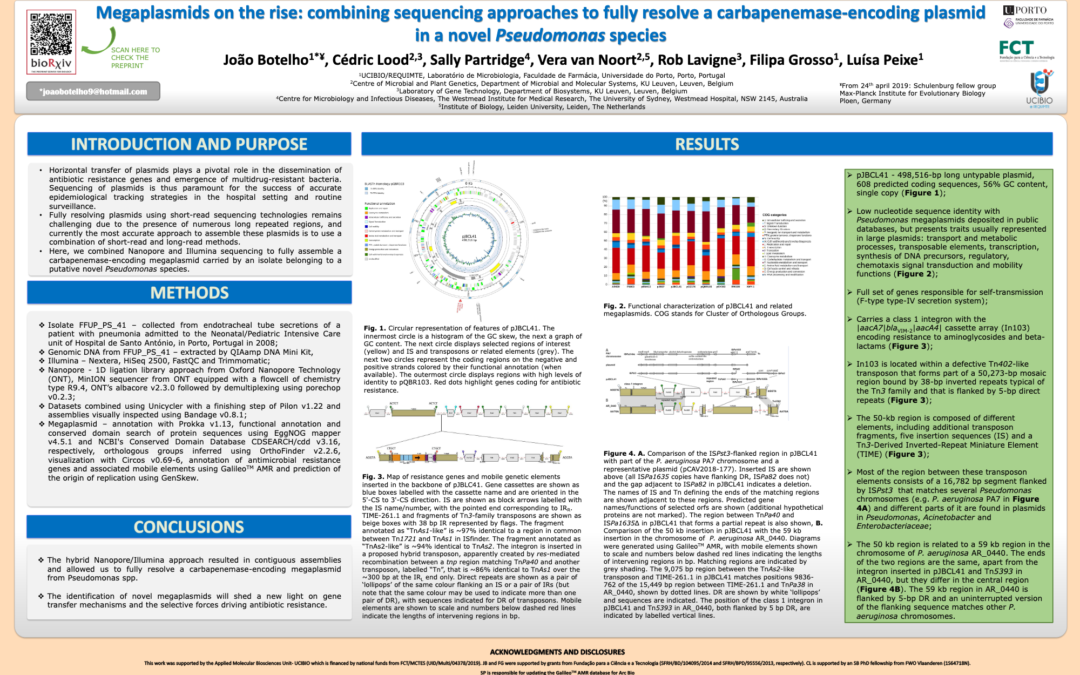
Poster – Megaplasmids on the rise: combining sequencing approaches to fully resolve a carbapenemase – encoding plasmid in a novel Pseudomonas species

Poster – Megaplasmids on the rise: combining sequencing approaches to fully resolve a carbapenemase – encoding plasmid in a novel Pseudomonas species

Detection of Antimicrobial Resistance

Poster Presentation at the 9th European Congress of Clinical Microbiology & Infectious Diseases (ECCMID 2019)
Learn more about Galileo™

Megaplasmids on the rise: combining sequencing approaches to fully resolve a carbapenemase – encoding plasmid in a novel Pseudomonas species

This poster was presented at the 29th European Congress of Clinical Microbiology & Infectious Diseases (ECCMID), which took place in Amsterdam in April 2019 by Dr. João Botelho at UCIBIO/REQUIMTE, Laboratório de Microbiologia, Faculdade de Farmácia, Universidade do Porto, Porto, Portugal.

Abstract:

“Horizontal transfer of plasmids plays a pivotal role in the dissemination of antibiotic resistance genes and the emergence of multidrug-resistant bacteria. Sequencing of plasmids is thus paramount for the success of accurate epidemiological tracking strategies in the hospital setting and routine surveillance.

Fully resolving plasmids using short-read sequencing technologies remains challenging due to the presence of numerous long repeated regions, and currently, the most accurate approach to assemble these plasmids is to use a combination of short-read and long-read methods.

Here, we combined Nanopore and Illumina sequencing to fully assemble a carbapenemase-encoding megaplasmid carried by an isolate belonging to a putative novel pseudomonas species.”

[pdf-embedder url=”/wp-content/uploads/2019/06/posterECCMID2019.pdf”]

For research use only. Not for use in diagnostics or diagnostic procedures.

Do you have a Question about Galileo™

We’d love to hear from you! Do you have any questions about the Galileo™ Platform?